Preventing chronic diseases through fun self-cultivation.
VITA
We were approached by a non-profit health organisation (VITA) to help combat the risk of chronic disease. The result is VITA, a habit changing app that aims to prevent chronic illnesses by helping people adopt a healthier eating lifestyle.
Role
Product Designer
Timeline
2 Weeks, Group of 4
Project Stack
Figma, Adobe Creative Suite
The Problem
Changing a habit is hard and maintaining a healthy one is even harder.
In Australia,  9/10 people are predicted to have their life span shortened from chronic diseases. Fortunately, most of these cases are completely preventable just by making better lifestyle choices. It's a wonder then, why chronic diseases still persist to be the most prevalent cause of death in our society.
Our high level goal was to...
Help people develop healthier diets and making sure they stay committed to that lifestyle.
Studies have shown that the most impactful method in reversing chronic diseases is in making better decisions in your diet- it starts with what you eat.  There’s an opportunity then to utilise healthy eating habits as the main driving factor in addressing our problem.
Scoping out a mobile-first approach
Meet the VITA App
Encourage
Take those first steps by creating a highly flexible, personalised and forgiving journey.
Change the language & perception
By starting with a more conversational and personalised tone, the first steps could be less daunting.
Small wins at a time
Break down the first steps into smaller achievable goals, and choose how you would like to tackle them.
Celebrate and reward
Normalise set-backs and celebrate greatly when progress is made.
Motivate
VITA continues to provide motivation on different levels and forms to keep the momentum rolling.
You are your biggest supporter
The strongest form of motivation is one that comes intrinsically.
Your North Star
VITA will regularly remind you on your 'BIG WHY' to keep you from losing sight of your goal.
Time Capsule
Prepare encouraging messages at the start of your journey to cheer on 'future you'.
Inwards Reflection
To make inward reflections more apparent, VITA promotes a more visible sense of ownership by using the metaphor of caring for a plant — which is a parallel to their own health.
Support
Track your progress in real time and receive all the crucial support you need to maintain a positive change.
Diary & Progress Tracker
Record and track your progress throughout the journey to learn how you could perform better.
Power in Knowledge
Reliable resource library to help empower users with the right mindset and information.
Grow better together
If you want to go fast, go alone. If you want to go far, go together.
Community Garden
Users are able to share resources and learn from other's success and struggles. Having an in-house dedicated expert within each group also helps to ensure everyone feels supported, and well-informed.
How we did it
Outlining a research plan
“Before solving a problem, identify first that you are solving the right problem...”  With this in mind, we establish a research plan to lay out our assumptions, research goals, questions and methodologies.
  • Understand current landscape to identify an opportunity to enter market
  • Discover people’s attitudes and perception around health to better resonate with their actual values
  • Understand our user’s needs, motivations and barriers for change to create long lasting solutions
Competitive Analysis
Scoping out the big players
To understand who we’re up against, we looked into both direct competitors (healthy/fitness apps) and indirect competitors (habit changing apps) and analysed them against a set of parameters.
Literary Research
So how do they do it?
As the research directed, we wanted to further immerse ourselves in the world of health and habit changing by supplementing our findings with relevant literatures and research papers on habit building. We looked at several habit building frameworks, particularly the widely used Hooked Method shown below.
This forms the basis of our approach towards the app features later on.
User interviews
Validating what we know
We first sent out a large-scale survey to map common challenges. Based on the quantitative trend of our survey, we then reached out to multiple health communities, facebook groups and our own networks to conduct one-on-one interviews.
206 Survey Responses , 26 Virtual Interviews later...
What we found from this...
Key Insight 1
People want to secure a future where they are still able-bodied.
90% of interviewees revealed that the main reason for eating healthier is for the long term benefits of remaining healthy and able-bodied at the later age.  Many even mentioned of being afraid to see themselves in a frail state.
Need: People need to be reassured that these diets have visible and direct health benefits on their body.
Key Insight 2
The new lifestyle has to be flexible, balanced and sustainable.
Most people mentioned that they have tried fad diets due to promises of seeing fast results. However, those diets are typically far too restrictive and fast-paced that they often find themselves feeling miserable or unfulfilled.
Need: People prefer a progressive climb even if it means having to continue doing it for a longer time.
Key Insight 3
It's extremely difficult to stay committed after starting.
The biggest challenge during the a diet change is to actually keep on track and stay committed to the change. Most people reportedly quit within the first 2-4 weeks of their new lifestyle.
Need: People need additional support and motivation, especially during the early phase of transition.
Pivoting based on research
Revisiting the brief
It’s interesting to note that the initial brief given by VITA was to encourage people to eat better by going completely plant based. 🥦

However, the research eventually revealed that most people do not correlate healthy eating with just eating plant based food, but rather on maintaining a balanced eating options. Many users instead find it very challenging if eating healthy means being limited to only plant based food.

And so as directed by our findings, we pivoted the goal from encouraging plant-based food diets to another method that resonates and works more effectively with users  — maintaining a well balanced and flexible diet.
Persona
Keeping it user focused
After identifying common mindsets and behaviours in our research phase, we developed a persona to succinctly address our group of users. This helps keep our subsequent ideation user-focused and ensure everyone is on the same page on who we are designing for.
Define and Ideate
Solving the problem right
To reframe the core problem into actionable solutions, we broke down the problem statement into “how might we” statements for each of the persona’s attributes. So how might we....
keep Fiona encouraged to commit to her newly established eating lifestyle?
help Fiona feel supported in this journey
help Fiona build a stronger relationship and respect with her current and future self?
At this point, the goal was to generate as many potential solutions
Product Strategy
Keeping it MVP
To help keep the product laser-focused, we decided to take a step back, zoom out and consider the various product goals and objectives of the various parties involved.
Feature Prioritisation
To further prevent a potential feature-bloat, we created a feature roadmap and categorise them using the MoScoW framework and Impact - Effort. This helps determine the product vision ahead of the MVP stage as well.
Structuring the information
Information Architecture
and User Flow
To make our app accessible even to the older demographics, we recognise that the app structure should be kept as simple as possible. Utilising a simple card sorting exercise, we compartmentalised the app’s navigation with a broader width rather than depth to help users discover features more easily.
I explored a few original workflows for user stories based on the problems we found. We tried to pare it down to the most essential workflows for an MVP.

I want to be able to track and accomplish my daily tasks quickly.
I want to be able to actively see my progress so far.
Prototyping
Rapid mid-fi prototypes for testing
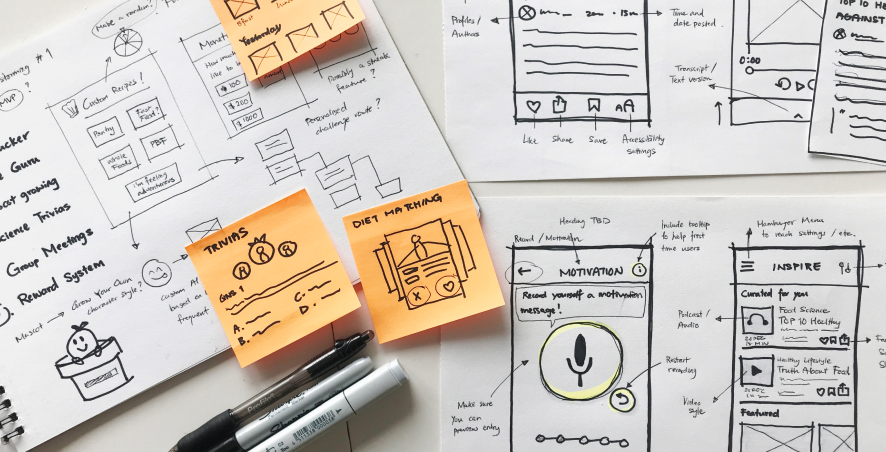
We rapidly drafted a paper prototype to validate design decisions and make iterations. The main goals for these tests are to validate user flow, identifying grows and glows for the user interfaces, and to check the clarity of content and hierarchy.
Feedback, Usability Tests and feedback
Mental model mismatching
We usability tested with 10 people who had use cases for tracking their progress, setting up their journey, and finding support. Places where our assumptions broke down were:
01. Key Insight
People want more information available from a quick glance.
So we brought forward more relevant info and features onto the home screen so users can easily discover them.
02. Key Insight
Over customisation can be paralysing and confusing.
So we introduced templates and guided suggestions for users to onboard and set-up their journey.
03. Key Insight
Community groups could feel more of a support group.
So we re-organised ‘groups’ not only by location but also on similar goals, needs and transition stage.
Branding
Tending to a living plant,
tending to yourself
By using the metaphor of caring for a plant, VITA helps to physically represent one’s personal health into a more visible, tangible form. Drawing parallel on how our body behaves very much like a plant — we can get healthy or sick based on what we absorb as our nutrients, we bloom better when we’re giving it the right support and care.
Hi-fidelity Prototype
Putting it all together
Reflections
Research plenty but also prioritise - Although this is a research heavy project, we spent almost 80% of our time conducting literature research which mostly ended up not being relevant to our MVP / users. Getting insights and feedbacks from direct user testing proved to be equally valuable as well.


Focus on the high level mindsets/motivations - While building the attributes to our main persona, there was a constant struggle of making sure our persona is not becoming too generic / over encompassing of other personas. By focusing more on the mindsets, we were able to create more distinguishable user personas.
Next Steps
  • Seeking next stage stakeholder feedback & iterations
  • Consider content copy for a wider audience age group
  • Incorporating more priority features from backlog
  • Developing metrics to track things that glow or could grow